Showing posts with label BBC. Show all posts

Monday, March 30, 2020

The Argument: Aristotle to Thousands of Years


Aristotle's views on biology support the thesis that Essential Types of Life (horses, frogs, humans etc.) remain stable and vary within limits.  That is, stasis along with change that has a boundary.  There is an excellent episode of In Our Time with Melvyn Bragg (BBC) on Aristotle's Biology.  My interview with David Kitts, who taught Philosophy, Geology and History of Science, touches on Aristotle as well.

Now, when we combine this premise, stasis of Essential Types of Life (ETL's), with the fossil record, how do we proceed?  Tertullian pointed to fossils found on mountains as evidence of the Great Flood, the mega-catastrophe Earth endured just a few thousand years ago that even the founder of modern paleontology Georges Cuvier accepted.  Augustine saw fossils as the remains of creatures living before the Flood.  Martin Luther referred to fossils as being the result of the Deluge in his commentary on Genesis.  Agostino Scilla published a work in 1670 on fossils which he illustrated himself which pointed to the Flood as their cause. [1]

But what about the fossil order?  There are places on the earth where ALL the geologic periods overlay the Pre-Cambrian (Pre-Flood).  In fact, 23.2% of the Ordovician is directly on top of the Pre-Cambrian and 18.6% of the Devonian is directly on top of the Pre-Cambrian.  This would seem to imply a shrinking of the traditional geologic time scale.

What if most of the geologic record was part of a single event, how is the general fossil order explained?  Ecological zonation, shallow marine organisms would be in the lower layers, hydrodynamic sorting and the higher mobility of vertebrates seems to be the solution.  That is, there was no "Age of Trilobites" or "Age of Dinosaurs."

Now, if most of the rocks were formed rapidly, that is catastrophically, then we need to drastically reduce the traditional geologic timescale.  Derek Ager was President of the British Geological Association and wrote The New Catastrophism which provides a plethora of examples of rapid geologic action.  If most rocks formed fast, could this planet be young (thousands, not billions of years old)?

Is there a pointer that implies most of the geology came from one event?  Let's look at the Strontium ratio (87Sr/86Sr) combined with sea level changes through geologic time:

The fact that these graphs match up fits better with the idea the most of the rocks were made from a Singular Event of Rapid Geologic Activity (SERGA).  Did the giant dragonflies live Millions Of Years Ago (MOYA)?  Maybe not. 

For more cool info on the young earth, be sure to get your copy of Is a Young Earth  Possible? today!  Your feedback is most welcome:
  YoungEarthScience@yahoo.com

 
Note:
1) The Deluge Story in Stone by Byron Nelson (Bethany Fellowship, Minneapolis, MN, 1968), pp. 9, 10, 18.

Wednesday, November 6, 2019

Dragons, Dinos and The Next Truth (recent interviews)


Are dragons really dinos?  Check our interview with Justin Derby (TTOR) on my latest book Is a Young Earth Possible?  We touch on philosophy of science, biological essentialism, Mayan chronology and tons of other fun topics.  What's the connection between the common dating methods and the "double blind" procedure?  See the gripping video and get the true truth:

Maria Anna van Driel is a freelance investigative science journalist, foreign correspondent, columnist and the force behind The Next Truth magazine which challenges "accepted" science with a multidisciplinary approach.
The latest issue has a super interview on my latest book Is a Young Earth Possible?  Here's a sample:

Monday, July 24, 2017

Coal, Science Bias and Wal-Mart


Be sure to catch our latest video.  We tackle a potpourri of topics:  Thunder & C-14, Tree Rings & Ammonites,  Norman Macbeth (Darwin Retried), OMNI magazine & censorship ... #Rubio #NormanMacbeth #Darwin #AltMed #TreeRings

"I'm Just an Old Chunk of Coal (But I'm Gonna Be a Diamond Someday)" was written and originally recorded by Billy Joe Shaver, but became a big hit (#4 on the charts) when John Anderson released it.
But that raises the question, "How long does it take for coal to form?"  In the early 1980's chemists at Argonne National Laboratory created  artificial coal from naturally occurring materials.  They demonstrated that the coal formation process was much less severe than formerly thought.

E.A. Newell Arber (d. 1918) was a Professor at the University of Cambridge with a focus in paleobotany and wrote The Natural History of Coal.  Arber concluded that the close association of some coal seams with sandstones, shales and conglomerates provides "evidence of the rapid formation of coal." [1]

Many scientists have a bias against Young Earth Science (YES).  This is also common among academics and journalists.  CatherineBennett wrote a piece in the Guardian titled "The BBC’s fixation on ‘balance’ skews the truth" where she showed disrespect for the young earth viewpoint.

In contrast, Melvin Bragg (Chancellor of the University of Leeds) hosted a BBC radio program on the Age of the earth. [2]  Several comments supported YES.  There were apparently seven who favored YES and seven who agreed with the Old Earth view.  Is the BBC pro-YES?  Maybe not, but at least they gave the YES advocates an opportunity to argue their case.

I hope Catherine Bennett gets a copy of my book YES - Young Earth Science which defends a youthful world from history and science.  YES, you can even get it from Wal-Mart (online).


Notes:
1) The Natural History of Coal by E.A. Newell Arber (Cambridge Univ. Press, London, 1912), p. 133.

2) YES - YoungEarth Science by Jay Hall (IDEAS, Big Spring, TX, 2014), p. 190.

Monday, March 16, 2015

Weasels, Woody and YES

Don’t let Old Earth Fallacies (OEF’s) make a weasel out of you.  Be wise like Woody and seek the truth!  A woodpecker has an amazing tongue – could this have formed "by the accumulation of innumerable slight variations" (Darwin)? 


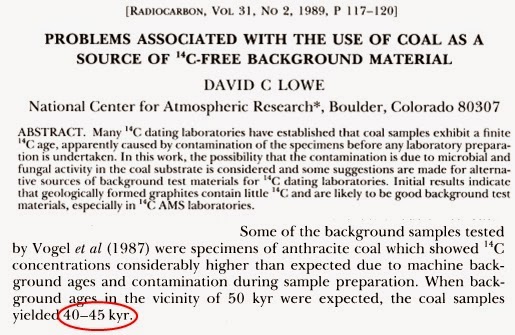
Did your grandparents use coal to heat their home?  If we date coal using radiometric dating methods, do we get millions of years?  Or, do we obtain a date of thousands of years?  YES‼


Go to your nearest coal mine and have a sample dated.  I predict that the coal will yield a date of less than 50K years.  Coal supports Young Earth Science (YES).


It does not take a rocket scientist to avoid OEF’s, just read YES – Young Earth Science to see the evidence. 

Here is a shortcut to the site:  TotalYouth.us


Weasel versus Woodpecker รจ YOU decide‼