Showing posts with label radiometric dating. Show all posts

Wednesday, July 1, 2026

Hunt for Young Earth


How can folks reach a conclusion on the Age of the Earth Controversy when “Guuglii” gives them the wrong answer?!


I searched Baidu (China) with this prompt: "Young Earth" best evidence in 2026

https://bit.ly/4v3A73P


And this popped up on the 1st page!

Five Global Evidences for a Young Earth by Jake Hebert (2019):

https://www.icr.org/article/five-global-evidences-for-a-young-earth/


We searched “Young Earth Science” on Gibiru:

https://gibiru.com/results.html?q=%22Young+Earth+Science%22&cx=partner-pub-5956360965567042%3A8627692578&cof=FORID%3A11&ie=UTF-8


On the 2nd page there was a profile of Dr. Russell Humphreys:

https://creation.com/en/articles/russ-humphreys-defends-creation


Oscobo gave some interesting results for this search >> fallacies of radiometric dating

https://www.oscobo.com/find.php?q=fallacies+of+radiometric+dating#gsc.tab=0&gsc.q=fallacies%20of%20radiometric%20dating&gsc.page=1


Please check out my books that defend Young Earth from History & Science:

Is a Young Earth Possible? - How Science and History Point to a Youthful World and Why it Matters ★★★★½

https://www.amazon.com/Young-Earth-Possible-Science-Youthful/dp/1088860788/


YES - Young Earth Science ★★★★

https://www.amazon.com/YES-WorldView-Fallacies-Darwinism-2014-11-14/dp/B01K3RF10I


Our new podcast:

https://thenewscasters.com/true-truth-weekly/


My books challenge Darwin & Deep Time (vids & podcasts 2): 

https://totalyouth.us/


** kudos – graphic sources:

https://www.nature.com/articles/ncomms10422/figures/3

https://chatgpt.com/c/6a45d3ac-8ae8-83ea-9954-b562aed5543e 

Monday, February 1, 2021

A Challenge to the Deep Time Paradigm

According to a paper on "Uncertainties in Age Dating" by C.S. Noble and J.J. Naughton published in Science, radiodating is not all that:


The radiogenic argon and helium contents of three basalts erupted into the deep ocean from an active volcano (Kilauea) have been measured.  Ages calculated from these measurements increase with sample depth up to 22 million years for lavas deduced to be recent.  Caution is urged in applying dates from deep-ocean basalts in studies on ocean-floor spreading. ...it is possible to deduce that these lavas are very young, probably less than 200 years old. [1]


If radiometric dating can't give us the correct answer for rocks of known age, why should we trust it for a stone allegedly billions of years old?

Way back in the 1970's, the New York Times was not afraid to oppose the Deep Time Syndicate:


A fundamental assumption of nuclear physics - the predictable decay rates of radioactive materials - has been opened to question on the basis of research reported here today at the national meeting of the American Chemical Society.  ... Dr. John L. Anderson, a Tennessee chemist, described experimental  observations with radioactive carbon14 that he said “just do not fit the accepted theory.” ... Dr. Willard F. Libby [who developed 14C dating], a Nobel Prizewinning chemist at the University of California at Los Angeles, said: “I must say I've racked my brain about what's going on in his data. It's a real bag of worms.” ... Dr. Anderson said that his observations indicated that the decay rates might not be as constant as  assumed.  Other forces, perhaps from adjacent atoms, could alter the process, he said.


One application of accelerated nuclear decay is aiding the safe and sure disposal of radioactive wastes from nuclear power plants.


From a more recent item in Geology in 1990, Ajoy Baksi (Geology Dept., Louisiana State Univ.) dropped the kraken on isotope dating: "Subjective and, in many instances, incorrect use of radiometric data has become endemic in the earth science literature.  Mathematical analysis of imperfect and, in many cases, highly subjective data sets leads to dubious conclusions." [2]

In contrast to the humility shown by Baksi, some researchers seem blinded by their own bias.  Think about this manifesto from the founder of the modern series of Scientific American, Gerard Piel (d. 2004):


A scientist has no system of absolutes to tell him whether he is right or wrong ... He can trust no authority but his own judgment. ... In biology, all of us are Darwinians; we perceive the unity of our species with all other living things and find a new reverence for life in the realization that we are the terminal point of its  evolution on our planet. ... All of us, in brief, are scientists.  With the overthrow of received  authority and the banishing of superstition, we are comprehending that it is man's destiny to make himself. [3]


First off, there are hundreds (if not thousands) of biologists who reject Darwinism.  The authority of Big Science tells us that the earth is old, but what if they are wrong?  An AP-GfK poll from 2014 found that 36% of Americans doubt Old Earth Fallacies (4.5B).  Are the transhumanists right?  Will humans develop into some more advanced being?  Who can fight the authority of Big Tek censorship? 


Notes:

1) "Deep Ocean Basalts: Inert Gas and Uncertainties in Age Dating" by C.S. Noble and J.J. Naughton, Science, vol. 162 (Oct. 11, 1968), p. 265.

2) quoted in Evolutionists Say the Oddest Things by Lita Cosner (Creation Book Pub., Powder Springs, GA, 2015), p. 93.

3) Science in the Cause of Man by Gerard Piel (Alfred Knopf, NYC, 1962), pp. 198-200/

#ScientificAmerican #DeepTime #YoungEarth #poll #survey #opinion #RadiometricDating #Geo #Geology #BigScience #BigTech #OldEarthFallacies  #Biology #Darwin #NewYorkTimes

Monday, December 14, 2020

Polling, Young Planets & the Decay of Radiometric Dating

During this political season have you received a call to answer some survey questions?  I have had one such call, but chose not to participate - it was Texas specific.  How does Young Earth Theory Intelligence (YETI) show up in public opinion polls?


First off, let's distinguish between various hot topics:

  How old is humanity?

  Is our home billions of years old?

  What is the age of the planet Venus?

During discussions on origins, these distinct questions may be blurred together.

We have a chapter in our book Is a Young Earth Possible? espousing a young Solar System.


Around the year 2000 about 47% of Americans of voting age held that humans started on this planet within the last 10K years.  That's almost half, for all my old pals in Rancho Cucamonga.  A survey in June of last year showed that 40% still held to the "young humanity" position.  I would argue the this is not only consistent with YETI but implies it.  The beginning of man and the origin of the world go together (cf. Mk. 10:6).


Here is my survey question that I would like to get national attention:

How old is the Earth?

A) 4,000 years

B) 6,000 years

C) 8,000 years

D) 10,000 years

E) more than 10,000 years.


A Harris poll found that 39% of Americans confirmed that the universe, the Earth, as well as all the plants, animals came into existence within the last 10K years.  The survey was conducted in 2009.  A superb article in the Tulsa World at least gave young-earthers' their say:


Rabbi Yehuda Weg, with the Chabad, an Orthodox Jewish community in Tulsa, said belief in a young Earth is widely held in the Orthodox Jewish world.Weg said Orthodox Jews believe the world is 5,775 years old [in 2015 AD] and that humans were created on the sixth day of the creation, according to the biblical record.  He said that date is not derived from adding up the years of the genealogies in Scripture but is consistent with those dates.  “It’s not like we figured out the date by adding up the genealogies. It’s the other way around. This is information we’ve (handed down) since the creation,” he said.


The article also highlighted the work of Jonathan Bartlett of Broken Arrow (OK), who defends a youthful world with geological evidence.  We recently took a trip to Broken Bow and picked up a "Vote for Squatch" shirt.


In contrast, the National Academies of Science (NAS) produced a work in 2008 which is extremely one-sided (Möbius anyone?).  Their book deals with origins, the age of the earth and related topics.  It highlights ten short comments from several scholars, social leaders, organizations and legal opinions.  Yet, not one response from the opposition to the mainstream view, biological essentialism (like begets like) and a young earth, is included.  The authors state that some, "have argued that science teachers should teach the 'controversies' surrounding evolution.   But there is no controversy in the scientific community about whether evolution has occurred." [1]  Is that really true?  Charles Bleckmann, writing in BioScience, brings out some opposition to Darwin during the late 1920's:


Not all biologists accepted evolution. ... Barrington Moore [d. 1966], the first editor of Ecology and a past president of the Ecological Society of America ... said, “I have no use for evolution and do not see how any intelligent person can have.”  Moore, a founder of scientific forestry in the United States, is now honored by the Society of American Foresters with a research award named after him. [2] 


For more recent examples of scientists who are Darwin Doubters, I would highly recommend Slaughter of the Dissidents by Jerry Bergman.


The NAS report has a segment on radiometric dating, but it fails to bring out the fact that it was not until an endorsement by a key scientific committee in 1926 that gave radiodating its supreme status as "proof" of Deep Time.  Dating rocks via radioactive isotopes is not all that.  A paper from Science mag (AAAS) drops the Kraken on Rubidium-Strontium dating:


One serious consequence of the mantle isochron model [a method that avoids knowing the initial daughter product] is that crystallization ages determined on basic igneous rocks by the Rb-Sr whole-rock technique can be greater than the true age by many hundreds of millions of years.  This problem of inherited age is more serious for younger rocks, and there are well-documented instances of conflicts between stratigraphic age and Rb-Sr in the literature. [3]


Research from the Geological Society of London exposes the radiodating skeptics: "Much still remains to be learned of the interpretation of isotopic ages and the realization that the isotopic age is not necessarily the geologic age of a rock has led to an over-skeptical attitude by some field geologists." [4]


Are there other methods of dating our wonderful world?  One technique is to look at various metals in the oceans:


The startling conclusion . . . is that most trace metals are at extremely low concentrations in the oceans and have rather unspectacular variations in their concentrations.  The calculated theoretical concentrations of copper, nickel, silver, gold, lead and other metals in the oceans are many orders of magnitude higher than the best currently measured values.  Why are the oceans so depleted of these trace metals?  Certainly it is not for the lack of availability from rock weathering ... [5]


The answer to the age-of-the-earth controversy is simple: stop the censorship and support free speech.  Our two most recent books provide evidence from history and science that favors Young Earth Theory Intelligence (YETI) and truly drops the Kraken on Deep Time:

          Is a Young Earth Possible?

          https://www.amazon.com/dp/1088860788

          YES - Young Earth Science

https://www.amazon.com/YES-WorldView-Fallacies-Collapse-Darwinism/dp/0692320075


Our website: https://totalyouth.us/


Notes:

1) Science, Evolution, and Creationism ed. by Francisco Ayala et al (National Academies Press, Wash. DC, 2008), p. xiii.

https://www.nap.edu/read/11876/chapter/1

2) "Evolution and Creationism in Science: 1880–2000" by Charles Bleckmann,  BioScience, Vol. 56, Issue 2, Feb. 2006, Pages 151–158,

https://academic.oup.com/bioscience/article/56/2/151/274042

3) "Ancient Lithosphere: Its Role in Young Continental Volcanism" by C. Brooks, David James and S.R. Hart, Science, vol. 193 (September 17, 1976), pp. 1086-1094, p. 1093.

https://www.researchgate.net/publication/6047264_Ancient_Lithosphere_Its_Role_in_Young_Continental_Volcanism

4) "Interpretation of Isotopic Ages in Orogenic Belts" by P.E. Brown and J.A. Miller, in Kent et al., "Time and Place in Orogeny," Geological Society of London Special Pub., vol. 3, (1969), p. 137.

https://www.researchgate.net/publication/238424166_Interpretation_of_isotopic_ages_in_orogenic_belts

5) "The Fate of Metals in the Oceans" by Karl Turekian, Geochimica et Cosmochimica Acta, vol. 41 (August 1977), pp. 1139-1144, p. 1139.

https://www.sciencedirect.com/science/article/abs/pii/0016703777901090?via%3Dihub


#DropTheKraken #TrueTruth #Geology #Origins #Worldview #YoungEarth #Polls #Surveys #Opinion #Science

Wednesday, February 5, 2020

A Young Earth with Critical Thinking (Rudwick)


Martin Rudwick's book Earth's Deep History: How It Was Discovered and Why It Matters came out in 2014.  So did my book YES - Young Earth Science which refutes much of Dr. Rudwick's content. 

Martin Rudwick is professor emeritus of history at the University of California - San Diego as well as affiliated scholar in the Department of the History and Philosophy of Science at Cambridge.

Rudwick seems to think that Aristotle and Plato go against the young earth view.  Both philosophers favored biological essentialism.  See chapter nine in my latest book on how essentialism naturally leads to supporting a planet of relatively recent origin.  Plato wrote of the disaster that destroyed Atlantis.  Once you favor huge catastrophes, then most of the rock record was formed rapidly.  If there is no major time gap between the layers (search "paraconformity"), then the "Millions Of Years Ago" (MOYA) goes extinct.

Interestingly, Earth's Deep History gives a critique of those scientists who go for Young Earth Science (YES) in an appendix at the back of the book.  A more balanced and related book is by my History of Science professor David Kitts, TheStructure of Geology.  Kitts work is one of the primary tomes on the Philosophy of Geology.  Kitts studied with Dobzhansky, GG Simpson (the greatest paleontologist of the 20th Century) and taught in 3 departments at the University of Oklahoma - History of Science (where he was chairman), Geology and Philosophy.

Kitts not only stresses the importance of presuppositions and worldview as geologists practice their trade, but also calmly discusses the challenge of overthrusts (older strata over younger beds) to mainstream science. [1]  Kitts realized that much of our geologic knowledge is limited, even with respect to radioactive dating. [2]  He further pointed out that the philosophical basis for saying that the fossil record "proves" evolution is weak. [3]  You can hear my interview with Dr. Kitts here.

Surprisingly, Rudwick's book does not contain the name "Ager" in the index.  Former President of the British Geological Association, Derek Ager, wrote an entire book on episodic geology - The New Catastrophism.  He even wrote a book as early as 1973 defending the thesis that most formations were created rapidly (The Nature of the Stratigraphical Record).  On the other hand, Rudwick does cover catastrophism to some extent, such as the Great Missoula Flood which was highlighted in a NOVA episode.

Rudwick deals with the Ice Age which is no problem for young earth theory.  I argue in my book Is a Young Earth Possible? that a recent global catastrophe is the key to explaining the Ice Age. [4]  Huge volcanism causes massive evaporation and precipitation.

In chapter ten of Earth's Deep History, Rudwick writes on the oceans.  The ocean floor in many places is covered with Manganese (Mn) nodules which are somewhat like pearls and grow from small bits of basalt and other materials.  The measured growth rates of these nodules indicate an age of only thousands of years. [5]

Rudwick deals with the Cambrian period many times in his book.  In the Cambrian, we find larger life forms compared to the Pre-Cambrian, some up to two feet.  It's a seldom mentioned fact that there is a Great Unconformity at the Pre-Cambrian/Cambrian boundary, as you can see in the Grand Canyon, which points to a global catastrophe which agrees with YES. 

Rudwick explains radiometric dating on a number of pages, but does it really deserve the trust as a magic clock that many scientists give it?  Geologist Bates McKee, writing in a book on the geology of the Pacific Northwest (McGraw-Hill), makes this stark admission:    

One might imagine that direct methods of measuring time [radiometric dating] would make obsolete all of the previous means of estimating age, but these new "absolute" measurements are used more as a supplement to traditional methods than as a substitute.  Geologists put more faith in the principles of superposition and faunal succession than they do in numbers that come out of a machine.  If the laboratory results contradict the field evidence, the geologist assumes that that there is something wrong with the machine date. [6] 

Please consider writing a positive review of my latest book, Is a Young Earth Possible?, on Amazon.

So, what do you think about Rudwick's book Earth's Deep History?  Let us know:


Notes:
1) The Structure of Geology by David Kitts (SMU Press, Dallas, 1977), pp. xviii, xix, 79-82, 110-113.
2) Ibid., p. 32.
3) Ibid., pp. 160-162.
4) Is a Young Earth Possible? by Jay Hall (Institute for Catastrophism and Tectonics - iCAT, Big Spring, TX, 2019), pp. 264-266.
5) Ibid., pp. 66-68. 
6) quoted in Deep Time Deception by Michael Oard (Creation Book Publishers, Powder Spring, GA, 2019), pp. 105, 107.

Wednesday, January 31, 2018

Does Google censor Young Earth Science (YES)?


First, to make plain the grammar - I am not saying that I have definite proof that Google is censoring the young earth view, but I would love to have your feedback on this question.  One opinion piece from US News claims that Google is the world's biggest censor.  Project Veritas recently released video proof that exposed Twitter for banning  views that run counter to the Silicon Valley mindset.

One interesting paper in Nature from some Japanese researchers last year showed that lightning can produce gamma rays which can lead to the formation of Carbon-14.  Of course this would require some revisions in radiocarbon dating which does not consider this source.  When was the last time you dated some coal or a dino bone using the C-14 method?  My prediction is that you will get thousands of years and not millions.

Another paper that did not get much attention is from the American Nuclear Society.  Robert Hayes points out that not taking into account differences in diffusion rates can lead to serious errors (the isochron method is intended to improve radiometric dates):

By taking into consideration the isotope effect (differential mass diffusion rates) when measuring isotopic ratios from very old samples, the distribution dependency in the coefficient ratios will cause a bias if isotopic diffusion rates are not identical throughout a sample.  The isotope effect is that isotopes having a smaller atomic mass will diffuse faster throughout a medium than will their heavier counterparts causing concentration gradients of their ratios even when there are no contributions from radioactive decay. The application to Rb/Sr dating is evaluated and shown to result in expected age overestimates when isotopic ratios are employed to linearize the isochron.  ...  the only method to fully eliminate the isotope effect is to not use isotopic ratios at all in radioisotopic dating as the physics do not require the use of isotopic ratios for geochronological dating.  However, without the ratios, the data are inherently noisy. [emphasis added]

So we see that the data favors Young Earth Science (YES).  Be sure to get our book which supports a youthful world from history, philosophy and science.  Does Google censor YES?  Let us know what you think:

**special thx to Jay Wile for the heads up on lightning & diffusion rates

Saturday, May 21, 2016

From YOLO to FROYO

When was the last time you heard YOLO (You Only Live Once)?  Or maybe BOGO  (Buy One, Get One)?  Here are a few more interesting expressions:

ARML = Age Related Memory Loss
ICYMI = In Case You Missed It
INO = I know
FOMO = Fear Of Missing Out
ZNO = Zeno (~d. 430 BC, philosopher)
FROYO = Frozen Yogurt
ROLO = candy
FIDO = Forget It, Drive On! (made famous by Zig Ziglar)
Stephen Jay Gould proposed the concept of Non-Overlapping MAgisteria (NOMA).  I have an alternative, MOMO (Multiple Overlapping Magisterial Overseers).  Consider the key leaders of Biology, Archaeology, History and so on.  They overwhelming favor Old Earth Fallacies (OEF).  In 1926, a committee of the National Research Council put their stamp of approval on radiometric dating.  Arthur Holmes, leader in the push for radiometric dating, wrote most of the report. [1]
Have you heard of MOYO (Millions Of Years Old) or BOYO (Billions Of Years Old)?  Our book YES- Young Earth Science counters the  MOYO/BOYO coalition.  If you've read the book, your feedback (Pro or Con) is most welcome:  YoungEarthScience@yahoo.com

If you are interested in opening a FroyoWorld franchise, it may cost you as much as $305K to $470K.  The very next time you're on I-20 be sure to visit Froyo's and More in Big Spring, TX (just East of Midland/Odessa).  It's grrreat‼
 

Note:

1) YES - Young Earth Science by Jay Hall (IDEAS, Big Spring, TX, 2014), p. 50.

Wednesday, March 2, 2016

The Politics of Old Earth

              *** UPDATE ***
Be sure to catch our latest video.  We tackle a potpourri of topics:  Thunder & C-14, Tree Rings & Ammonites,  Norman Macbeth (Darwin Retried), OMNI magazine & censorship ... #Rubio #NormanMacbeth #Darwin #AltMed #TreeRings

Hotep = B @

Ben Carson, Marco Rubio and Rick Perry (now supporting Ted Cruz) have all faced the age-of-earth controversy.  Politicians have engaged the old earth/new earth issue, but what about the power struggles and sociology of science that has led to a 4.5B year old planet?

Around 1900 there was a wide range of estimates for the earth’s age that were seriously considered.  Hermann von Helmholtz gave a date of 22M years based on the sun’s loss of energy.  By 1931 Arthur Holmes used the results of radiometric dating to assert that this planet is at least 1.5B years in age. [1]

In 1883, Alexander Winchell, former State Geologist of Michigan, estimated that the age of the earth at 3M years.  Former president of the Geological Society of London, Andrew Ramsay (d. 1891), held that the earth may be 10B years old! [2] 

Arthur Holmes, the most important person to make radiometric methods the dominant dating method, said in 1913, “It is now well known that if the proportion of radium in the interior of the earth is the same as that in the surface rocks, the earth ought to be growing hotter…” [3]  Did Holmes abandon his old earth PreSuppositions because of this contrary evidence?  No, he held tenaciously to his Deep Time WorldView. 
In 1921, at a meeting of the British Association for the Advancement of Science, there was no consensus on radiometric dating and an Earth that’s billions of years old.  In 1926, a committee of the National Research Council concluded that radiometric dating was the only reliable method to date rocks.  Arthur Holmes, who led the campaign for radiometric dating, wrote 70% of the report.  What in the politics of science changed between 1921 and 1926?  Scott Frickel and Kelly Moore have edited The New Political Sociology of Science (Univ. of Wisconsin Press) which tackles the power struggles in the research establishment.
To learn more about this drama in science, be sure to get your copy of YES - Young Earth Science today!  Chapter Two deals with the history of radiometric dating.  This fully documented work has over 450 footnotes and more than 130 charts, graphs and illustrations.


Notes:
1)  YES - Young Earth Science by Jay Hall (IDEAS, Big Spring, TX, 2014), p. 17.   
2)  Ibid., p. 50.
3)  quoted in Hall, p. 40

M=million, B=billion (10^9)

Wednesday, September 9, 2015

YES - the Young Earth Science podcast 2079

How old is the earth?  Does it matter?  On today's podcast we will see how radioactive dating supports a young planet.  Click here to learn more.  Consider this shocking admission from R.L. Armstrong writing in the New Zealand Journal of Geology and Geophysics:  

This is an inherent uncertainty in dating young volcanic rocks: anomalies may be detected only by stratigraphic consistency tests, independent dating techniques, and comparison with the known time scale of geomagnetic reversals during the last five million years. [1]

If radiometric dating has an epic fail on historic lava flows, how can we trust it for old rocks supposedly billions of years old?  Let’s labor to spread the news about a youthful world.  The Truth is out there – fight the Deep Past.
What is your reaction to these words of H.G. Wells (War of the Worlds)?  “The past is but the beginning of a beginning, and all that is and has been is but the twilight of the dawn.” – H.G. Wells

What evidence would be required to verify a young earth?  Let us hear from you:  YoungEarthScience@yahoo.com
Learn more about Young Earth Science (YES) by getting the bold new fully documented book.


Note:

1) “K-Ar Dating: Late Cenozoic McMurdo Volcanic Group and Dry Valley Glacial History, Victoria Land, Antarctica” by R.L. Armstrong, New Zealand Journal of Geology and Geophysics, vol. 21 (1978), p. 692, emphasis added.

Monday, March 16, 2015

Weasels, Woody and YES

Don’t let Old Earth Fallacies (OEF’s) make a weasel out of you.  Be wise like Woody and seek the truth!  A woodpecker has an amazing tongue – could this have formed "by the accumulation of innumerable slight variations" (Darwin)? 


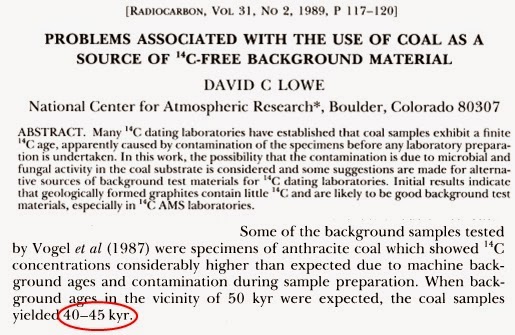
Did your grandparents use coal to heat their home?  If we date coal using radiometric dating methods, do we get millions of years?  Or, do we obtain a date of thousands of years?  YES‼


Go to your nearest coal mine and have a sample dated.  I predict that the coal will yield a date of less than 50K years.  Coal supports Young Earth Science (YES).


It does not take a rocket scientist to avoid OEF’s, just read YES – Young Earth Science to see the evidence. 

Here is a shortcut to the site:  TotalYouth.us


Weasel versus Woodpecker è YOU decide‼